The Pointing Problem
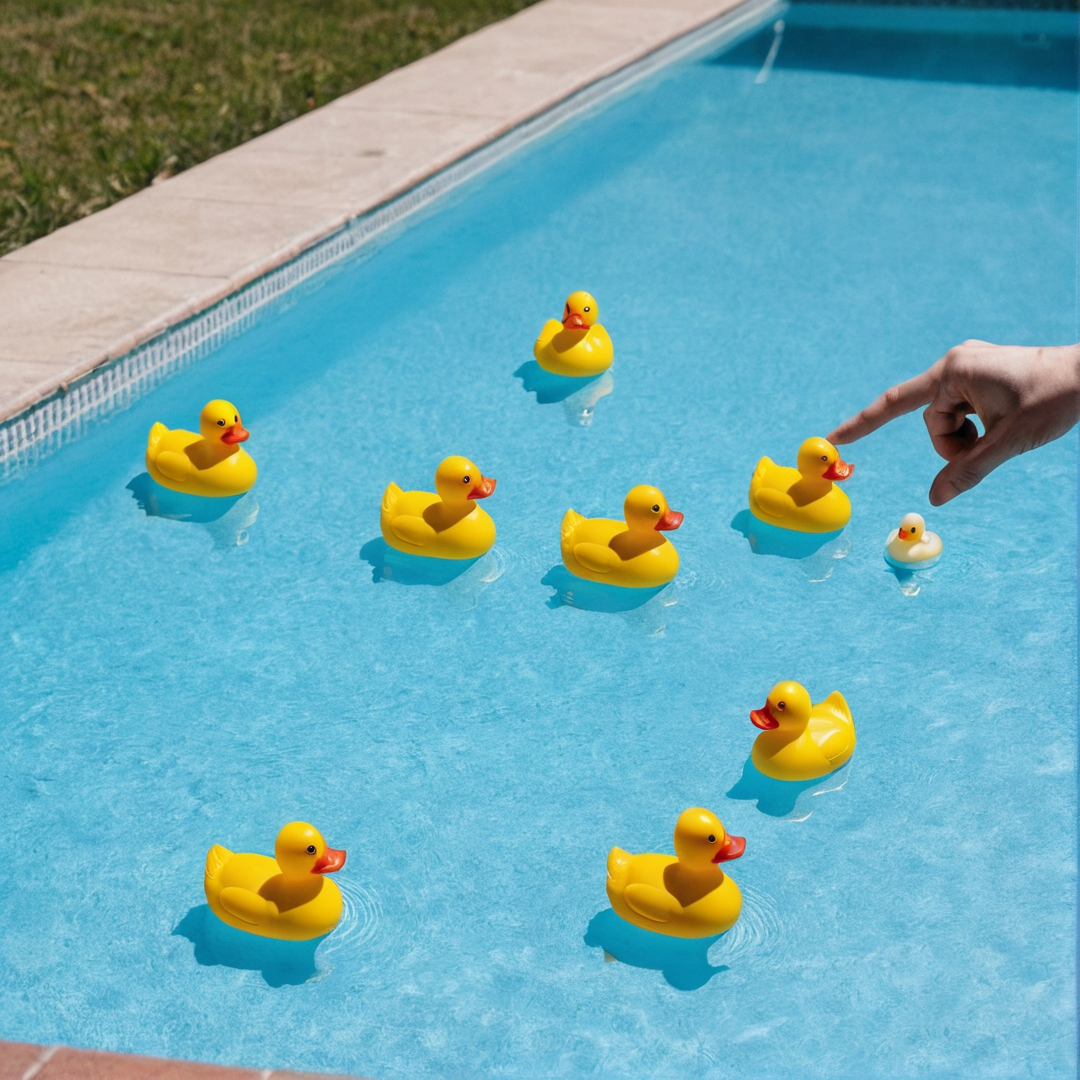
You point at a duck. I look where you're pointing. We're both looking at different ducks.
The Setup
Imagine we're standing by a pond. It's a calm day, the water is still, and there are about twenty ducks floating across the surface. You're standing on the north side, I'm standing on the east side, maybe fifteen meters away from you.
You spot the duck you want to talk about. You raise your arm and point.
"That one," you say.
I follow the line of your arm, extending it across the pond. From where I'm standing, your finger seems to be pointing at a completely different duck than the one you're seeing.
Why This Happens
It's simple geometry, really. Your pointing finger creates a line through three-dimensional space. But that line doesn't stop at the duck you're looking at - it keeps going. From my angle, standing in a different position around the pond, that same line passes through different ducks at different depths.
You might be pointing at the duck closest to you. But from my perspective, that line could be passing over three other ducks before it reaches the one you mean.
We're both looking at the same pond, following the same gesture, but we're seeing different things.
The Translation Problem
This is what happens every time we try to share a specific point in semantic space.
When you point at an idea - when you use words to indicate a concept - you're creating a line from your perspective through conceptual space. But I'm standing somewhere else. My perspective is different. The same words, the same gesture, passes through different concepts for me.
You say "the duck" and point. I see a duck. But it might not be your duck.
What Makes It Harder
Now imagine the pond has fifty ducks. A hundred ducks. A thousand ducks, all floating, some close together, some far apart, some moving slightly in the gentle current.
You point. "That one."
From your position, it's obvious which one you mean. From mine? The line of your pointing finger passes through dozens of ducks. I have to guess which one you're actually indicating.
This is the fundamental ambiguity problem in communication. Not because we're being unclear - but because we're standing in different places.
The Same Words, Different Meanings
You stand on the north side and say "the duck near the edge."
I'm on the east side. Near which edge? Near the edge from your perspective, or from mine? The duck that's near the northern edge is nowhere near the eastern edge.
The words are precise. The pointing is intentional. But the perspective difference creates ambiguity.
Why Position Matters
If we were standing in exactly the same spot - shoulder to shoulder, looking from the same angle - your pointing would work perfectly. I'd see exactly what you see. The line from your finger would pass through the same ducks in the same order.
But we're never in exactly the same spot. Every person has a slightly different position around the pond. Every mind has a slightly different perspective on conceptual space.
Your "that one" is different from my "that one," even when we're looking at the same pond.
What This Means
This isn't a problem to solve. It's a fundamental property of how pointing works in space - physical or semantic.
When you point, you're creating a line from your position. That line intersects with many possibilities. The person receiving the point has to interpret which intersection you meant.
Sometimes it's obvious. The duck you're pointing at is isolated, far from others, clearly distinct.
Sometimes it's ambiguous. The duck you're pointing at is in a cluster, surrounded by similar ducks, and the line from your finger passes through all of them.
The Takeaway
Communication through language is like pointing at ducks from different sides of a pond.
The words create a vector - a line through semantic space. But that line passes through many concepts. The listener, standing in a different position, has to interpret which concept along that line you actually meant.
It's not miscommunication. It's perspective.
Part of the Duck Pond Experiments series - making abstract concepts concrete.